
Healing Through Art: Embodying Divine Feminine Power
For many spiritual women in North America, the journey of healing goes far beyond talk therapy or self-help books. Creating art becomes a direct portal to body awareness and divine feminine energy, allowing you to reclaim what shame or trauma once silenced. Research shows expressive arts therapies use mindful breathing and sensory engagement to anchor healing deep into your physical form, offering a sacred path where creativity, embodiment, and spiritual transformation move together.
Table of Contents
- Defining Healing Through Art And Embodiment
- Divine Feminine Energy And Kundalini Activation
- Types Of Healing Art And Ritual Practices
- Shadow Integration And Reclaiming The Female Body
- Spiritual, Sensual, And Transformative Impacts
- Common Pitfalls And Cultural Misconceptions
Key Takeaways
| Point | Details |
|---|---|
| Healing through Art | Engaging in creative expression serves as a pathway to self-discovery, allowing individuals to transform trauma into healing by connecting with their body and emotions. |
| Embodiment Practices | Grounding oneself in the present during creative practices is crucial for genuine transformation, integrating body sensations with emotional expression. |
| Divine Feminine Energy | Reclaiming the feminine essence through art activates intrinsic power and promotes healing, encouraging a harmonious connection between spirituality and sensuality. |
| Avoiding Misconceptions | Approach healing art with intention and awareness, recognizing that it is not merely about expression but requires active engagement and integration to be truly transformative. |
Defining Healing Through Art and Embodiment
Healing through art is not about creating something technically perfect or aesthetically pleasing for an audience. It is about using creative expression as a somatic portal, a direct pathway into your body’s wisdom and your soul’s truth. When you engage with art in this way, you are not simply making marks on a canvas or shaping clay. You are having a conversation with yourself, unraveling the stories your body has been holding, and reclaiming the parts of you that shame or trauma has silenced.
Embodiment, in this context, means becoming fully present and awake in your physical form. It means tuning into the sensations, emotions, and energy moving through you. Expressive arts therapies use sensory engagement and mindful breathing to help you connect with yourself beyond words, which is especially powerful when language alone cannot hold what you are experiencing. Your body carries memory. It holds patterns, contractions, and frozen moments from experiences you may not consciously remember. Art becomes the key that unlocks these stored experiences, allowing you to move through them, integrate them, and transform them. This is not psychology in the clinical sense. This is sacred remembrance.
When you combine these two elements, healing and embodiment become inseparable. Art offers you a nonverbal language to express what words cannot capture, while embodiment grounds that expression into your nervous system and your lived reality. The act of creating while remaining present in your body, feeling your breath, noticing your sensations, and honoring your intuition is where genuine transformation begins. You might paint rage, dance grief, sculpt the shape of your longing, or move through your fear. Each act of creation while inhabiting your body becomes a ritual of reclamation. You are telling yourself that your feelings matter. Your body matters. Your truth matters. This is how art becomes medicine. Embodiment practices like mindfulness and touch during creative work deepen this healing process by anchoring awareness into the present moment and your physical sensations.
Healing through art and embodiment is also profoundly feminine work. It honors the cyclical nature of your body, the wisdom in your intuition, the power of pleasure and sensation, and the intelligence that lives beneath intellect. It challenges the cultural messages that taught you to distrust your body, to control your emotions, to separate your spirituality from your sensuality. When you create from an embodied state, you are not just healing yourself. You are breaking generational patterns, reclaiming your power, and anchoring divine feminine consciousness back into flesh and blood. This is revolutionary. This is how we heal the wound of separation between spirit and body, between the sacred and the sensual.
Pro tip: Start small by setting aside fifteen minutes to create something without judgment, whether drawing, painting, or moving, while paying close attention to what sensations arise in your body as you express yourself.
Divine Feminine Energy and Kundalini Activation
Divine feminine energy is not something separate from you. It is not a concept to study or a goal to achieve. It is the living force within your body right now, waiting to be remembered, activated, and embodied. In spiritual traditions rooted in tantric philosophy, this energy is called Shakti, and it exists as raw creative power, sensual aliveness, intuitive knowing, and the capacity to birth transformation. Kundalini is the concentrated form of this feminine energy, often described as a coiled serpent resting at the base of your spine. When awakened through conscious practice, movement, breath, and creative expression, kundalini rises through your energy centers, opening your body and consciousness to profound healing and spiritual expansion.
This awakening is not abstract or ethereal. It happens in your flesh, in your sensations, in the electricity moving through your nerves and the deepening of your breath. Art therapy integrates creative expression with spiritual energy awakening, activating kundalini through embodied, sensory engagement that bypasses the thinking mind and speaks directly to your body’s wisdom. When you paint with intention, move with presence, or create from a place of sacred sexuality, you are literally stirring this coiled power. You are inviting it to rise. You are saying yes to your own aliveness. This is why the act of creation becomes ritual, becomes medicine, becomes awakening. The blank canvas or empty studio space becomes a temple where you meet your own divinity.
Many women in North America have been taught to suppress their feminine power. You have been conditioned to minimize your sensuality, doubt your intuition, control your emotions, and distrust the cyclical wisdom of your body. Kundalini awakening reverses this conditioning. It demands that you reclaim your sexuality as sacred, your emotions as intelligent, your intuition as navigational truth, and your body as the home of the divine. Art therapy supports emotional regulation and inner power activation aligned with kundalini transformation, helping you release shame, integrate shadow aspects of yourself, and anchor new frequencies of self-love and embodied power. As this energy rises, you may experience waves of pleasure, spontaneous movement, deep emotion, or sudden clarity. You may feel tingling sensations along your spine, warmth in your belly, or trembling as your nervous system recalibrates. This is not dangerous or pathological. This is you coming alive.
When you work with art as a tool for kundalini activation, you are not trying to force anything. You are creating a container, a sacred space, where this energy can move naturally. You might work with color, recognizing that red ignites your root chakra grounding, orange awakens your sensual creativity, yellow illuminates your power center, green opens your heart, blue activates your authentic voice, indigo deepens your inner vision, and violet crowns your connection to the divine. You might paint mandalas or sacred geometry, each spiral and curve inviting your energy to circulate upward. You might create art that celebrates your body, your sexuality, your pleasure, your rage, your grief, your ecstasy. Each act of creation becomes a conversation between you and the divine feminine force moving through you. This is not vanity or self-indulgence. This is holy work.
Pro tip: Create a dedicated art space in your home where you can work with oils, pastels, or paints while focusing on your breath and inviting sensation to move freely through your body, allowing kundalini activation to happen naturally through your creative expression.
Types of Healing Art and Ritual Practices
Healing art takes many forms, and there is no single “right” way to work with creative expression for transformation. Different modalities speak to different people, and your body will guide you toward what you need in any given moment. What matters is that you show up with intention, presence, and willingness to let the art move through you without censoring or controlling the outcome. The most powerful healing happens when you surrender to the process rather than fixate on the product. Creative arts therapies employ diverse modalities including visual arts, music, dance, and writing to facilitate psychological and embodied transformation, reinterpreting bodily experiences through artistic processes. Each modality offers a unique portal into your nervous system and your soul.
Visual and Tactile Art Forms speak directly to your sensory intelligence. Painting allows you to translate emotion into color and mark, moving your hand across the canvas in patterns that reflect your inner state. Drawing with charcoal, pastels, or ink can ground you quickly into your body because the materials demand physicality and presence. Sculpture and clay work are particularly potent for embodiment because they require you to use your hands, feel resistance and malleability, and literally shape something with your touch. Collage offers a gentler entry point if you are intimidated by blank pages, allowing you to gather images and words that resonate with your healing journey, then arrange them into new meaning. Working with your own body as the medium, such as through henna, body painting, or temporary tattoos, reclaims your flesh as a canvas worthy of sacred adornment.
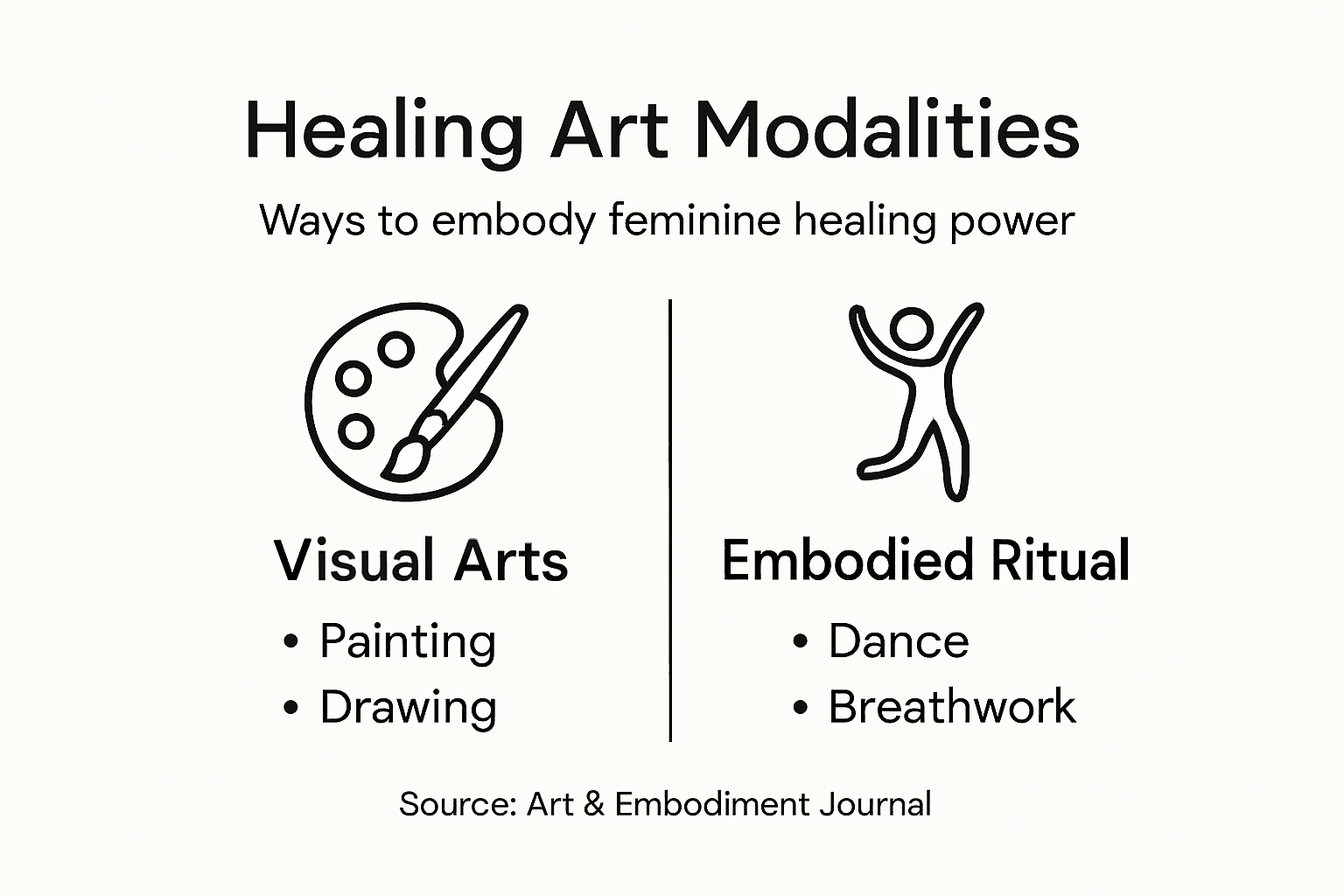
Movement and Embodied Ritual ground healing into your physical form. Dance, whether structured or intuitive, allows energy to move through your body without the constraint of words. Yoga, particularly slow, yin, or tantric practices, combines breath, movement, and awareness to activate kundalini and dissolve tension held in your tissues. Walking meditation in nature becomes a ritual when you slow down, notice your breath, feel your feet on the earth, and allow your senses to absorb the world around you. Somatic shaking or tremoring practices release stored trauma from your nervous system by allowing your body to discharge excess energy. Creating a personal ritual that combines music, candles, scent, and intentional movement transforms your healing work into ceremony, which signals to your psyche and spirit that this moment is sacred.
Writing and Verbal Expression bring your healing into language. Journaling allows you to pour unfiltered thoughts and feelings onto the page without judgment. Poetry distills emotion into imagery and rhythm, creating compressed truth that bypasses your rational mind. Letter writing, particularly letters you never send, gives voice to things you could not say to others or to yourself. Chanting, mantras, or sound work vibrate your body from the inside, shifting your energetic frequency and clearing stagnation from your throat and heart. Art healing practices integrate sensory, behavioral, and spiritual dimensions that work together to create comprehensive transformation. When you speak your truth aloud while creating, you anchor your healing into embodied reality rather than keeping it abstract or internal.
Ritual Practices Weave It All Together. A healing ritual might begin with grounding yourself through breath or movement, then move into creating art with a specific intention, and conclude with journaling or spoken affirmation. You might light a candle to mark the beginning, work in silence or with music, and close by thanking your body for its wisdom. Rituals need not be complicated or lengthy. They simply need to be consistent, intentional, and personally meaningful. They tell your nervous system, your body, and your spirit that you are worthy of care, that your healing matters, and that you are committing to your own transformation.
Pro tip: Choose one art modality that calls to you right now, commit to practicing it weekly for at least four weeks with minimal expectations about outcomes, and notice which sensations, emotions, or insights emerge from your body as you create.
Here is a summary of healing art modalities and their unique benefits:
| Modality | Primary Benefit | Example Practice | Embodiment Focus |
|---|---|---|---|
| Visual/Tactile Arts | Emotional release through touch | Painting, clay, collage | Physical sensation |
| Movement/Dance | Unlocks energy and emotion | Dance, yoga, shaking | Kinesthetic awareness |
| Writing/Sound | Integrates healing into language | Journaling, poetry, mantra | Expressive voice |
| Ritual Practice | Creates sacred space for healing | Breathwork, ceremony, music | Mindful intention |
Shadow Integration and Reclaiming the Female Body
Your body holds everything you have ever rejected about yourself. It holds the rage you were told was unladylike. The sexuality you were taught to hide. The hunger, the ambition, the wildness, the grief, the sensuality. These disowned parts of yourself do not disappear when you deny them. They sink into your tissues, your nervous system, your cells. They become what Jungian psychology calls the shadow, the split-off aspects of yourself that continue to operate beneath consciousness, often creating patterns of self-sabotage, shame, or disconnection from your own aliveness. Shadow integration means bringing these hidden parts back into consciousness, acknowledging them with compassion, and reclaiming their energy and wisdom. When you work with art as a tool for shadow integration, you are literally painting or sculpting the parts of yourself you have been taught to hide.
The female body in North America has been subjected to relentless messaging about what it should be, how it should look, what it should do, and what it should feel. You have been shown images of objectified female bodies, taught that your menstrual cycle is a burden, conditioned to fear your own pleasure, and warned that your body is dangerous if you claim it fully. These messages create a profound split between you and your physical form. You may feel disconnected from your own flesh, ashamed of your sexuality, afraid of your power, or numb to sensation. Art therapy facilitates shadow acknowledgment and reclamation of disowned feminine power through sensory-rich creative modalities, helping you restore fragmented aspects of your embodied identity. When you create art that celebrates your body, portrays your sensuality without apology, or expresses the rage and grief you have been holding, you are performing an act of reclamation. You are telling yourself that your body is not shameful. Your pleasure is not sinful. Your power is not dangerous. Your truth matters.
Shadow integration through art is not about becoming comfortable with things that are genuinely harmful or unhealthy. It is about distinguishing between authentic discomfort with real boundaries and the internalized shame that has been imposed on you. It is about reclaiming your right to occupy space in your body, to feel sensation, to experience pleasure, to express anger, to take up room. When you sit down to create art focused on your own body, your sexuality, your anger, or your grief, you may feel resistance. You may hear old voices telling you that it is inappropriate, vain, or selfish. These voices are the internalized patriarchy. Keep creating anyway. The more you externalize these shadow parts through art, the less power they hold over your choices and your life. Your body begins to feel like home instead of enemy territory.
Reclaiming your female body also means reclaiming the cyclical wisdom that lives within it. Your body is not broken when you menstruate, when your energy shifts, when your desires change throughout your cycle. Your body is intelligent. It is communicating with you. When you create art that honors your menstrual cycle, your changing moods and energies, your fertility or infertility, your aging, your pleasure, and your power, you are literally rewriting the cultural narrative that taught you your body was something to manage or transcend. You are anchoring new meaning into your flesh. You are telling yourself and the world that the female body is sacred, intelligent, generative, and worthy of reverence. This is revolutionary work. This is how we heal the generational wound of separation from ourselves.
Pro tip: Create a series of artworks specifically focused on the parts of your body or feminine experiences you have felt most ashamed of, allowing yourself to express anger, grief, or reclamation without censoring yourself, and notice how your relationship to your body shifts as you externalize these shadow parts.
Spiritual, Sensual, and Transformative Impacts
When you engage with art as a practice of embodied healing, you are not simply creating something aesthetically pleasing or emotionally cathartic. You are initiating a cascade of transformation that touches every dimension of your being. The impact ripples through your nervous system, your energy body, your relationships, and your spiritual consciousness. Your body begins to remember that it is not separate from your spirit. Your sensuality reconnects with your spirituality instead of being compartmentalized as separate or shameful. This integration is where true healing lives. This is where you become whole.
The spiritual impact of healing art is profound and multifaceted. When you create from a place of embodied presence, you activate what many call the creative force, the divine spark, the connection to something larger than your individual self. Many women describe art-making as a spiritual experience where they feel held, guided, or flooded with clarity that seemed impossible to access through thinking alone. Art therapy activates neurobiological networks that facilitate spiritual awakening and connection to deeper self, helping you move beyond psychological patterns into dimensions of consciousness and meaning. You may experience moments of flow where time disappears and you are completely merged with the creative process. You may receive insights about your life, your purpose, or your path forward. You may feel a profound sense of belonging to something sacred. These are not random occurrences. They are natural outcomes of creating with intention, presence, and an open heart. Your art becomes a bridge between your individual consciousness and your connection to the divine feminine, to Shakti, to the life force itself.
The sensual impact is equally essential and often the most surprising to women who have been taught to separate their sexuality from their spirituality. When you create art that honors your body, your pleasure, your sensuality, and your erotic power, something profound shifts. You begin to understand that sensuality is not separate from spirituality. Your skin, your senses, your sexual energy, your capacity for pleasure are not obstacles to enlightenment or barriers to the divine. They are the doorway. Your body is the temple. Your sensations are the language through which your spirit speaks to you. Art therapy fosters sensual embodiment by enabling emotional expression and deeper connection to life force energies, aligning creative practice with sacred feminine principles that honor pleasure as a path to wholeness. When you paint your desire, sculpt the curve of a sensual body, or dance with awareness of your skin and breath, you are not being vain or self-indulgent. You are reclaiming your right to inhabit your body as a sacred home. You are telling yourself that your sensuality is divine. This reclamation is revolutionary. It dissolves the false separation that patriarchy has imposed between the sacred and the sensual, between spirit and body, between enlightenment and pleasure.
The transformative impact ties all of this together. Real transformation is not a one-time event. It is a gradual rewiring of your nervous system, a slow dissolution of old beliefs, and a steady anchoring of new ways of being in your body and in the world. You may not notice it happening in the moment. But six months into a consistent art practice, you realize you speak differently about your body. You move with more presence. You feel less shame. You access your intuition more readily. You experience more pleasure without guilt. You are less reactive and more responsive to life. You set boundaries more easily. You know your worth. You trust yourself. These are the fruits of transformative healing work. Your art becomes the evidence of your own becoming. Each piece you create is a marker on your journey home to yourself.
Pro tip: Document your transformation by photographing or keeping your artwork in a dedicated journal, reviewing it monthly to witness the shifts in your creativity, your color choices, your imagery, and your embodied presence, which often mirror the spiritual and sensual transformations happening within you.
Compare how spiritual, sensual, and transformative impacts of healing through art differ:
| Dimension | Unique Impact | Signs of Change | Long-Term Effect |
|---|---|---|---|
| Spiritual | Amplifies sense of belonging | Greater inner clarity | Deepened self-connection |
| Sensual | Restores pleasure as sacred | Enhanced bodily awareness | Positive body-image |
| Transformative | Shifts beliefs, daily habits | Ease in boundary-setting | Sustainable personal growth |
Common Pitfalls and Cultural Misconceptions
Healing through art is powerful, but it is not a panacea. There are real pitfalls to be aware of, misconceptions that can lead you astray, and cultural blind spots that can undermine your work if you are not intentional. The first major pitfall is oversimplifying what healing through art actually is. Many people assume that making art is automatically therapeutic, that simply expressing yourself creatively will resolve trauma or transform your relationship with your body. This is not accurate. Art can be a powerful container for processing difficult experiences, but without presence, intention, and often skilled guidance, creating art can also be retraumatizing. You can create art and remain disconnected from your body. You can paint your pain and still dissociate from it. You can express rage on canvas and then push the rage back down afterward, accomplishing nothing except momentary release. The difference between creating art and engaging in healing through art is embodiment. It is the conscious presence you bring. It is your willingness to feel what arises and integrate it into your lived experience. Without this, art is just art.
Another significant pitfall is approaching healing art as a solo project without considering your own triggers, limitations, or when you might need professional support. If you have experienced significant trauma, particularly trauma related to your body or sexuality, creating art around these themes without proper containment can overwhelm your nervous system. Healing art practices require trauma-informed approaches that respect cultural contexts and avoid retraumatization through inappropriate interventions. This does not mean you should avoid creating art about difficult experiences. It means you should do so with awareness. You might work with a trauma-informed art therapist. You might create art in shorter sessions with grounding practices before and after. You might have a trusted friend or therapist present. You might combine your art practice with somatic therapy or body-based work. The goal is not to suppress your healing but to pace it so your system can integrate the work without becoming flooded.
Cultural misconceptions about healing through art are pervasive, particularly in North American contexts. Many people view art therapy or healing art as something frivolous, as self-indulgent hobby work rather than legitimate healing practice. This dismissal often comes from a patriarchal value system that prioritizes productivity, rationality, and measurable outcomes over somatic wisdom, intuitive knowing, and embodied transformation. When your family or friends minimize your healing art practice, they are reflecting this cultural conditioning. There is also a misconception that healing art must look a certain way or produce aesthetically pleasing results. You might feel pressure to create work that is beautiful, that makes sense, that tells a linear story. This pressure can block authentic expression. Your healing art does not need to be beautiful. It does not need to be coherent. It needs to be true. It needs to come from your body and your depths. Addressing cultural misconceptions requires recognizing neuro-psycho-cultural complexities and respecting diverse healing approaches rather than imposing Western therapeutic frameworks as the only valid path.
Another pitfall specific to women reclaiming their bodies and sensuality is the risk of performing healing rather than actually experiencing it. You might create beautiful images of the divine feminine or sensual bodies, share them on social media, and receive external validation without ever actually integrating the work into your nervous system or your real-world choices. Healing is not a performance. It is not for an audience. It is for you. The most profound healing often happens in private, in silence, where no one sees your work and no one validates your process. This does not mean you cannot share your art or find community around it. It means you must distinguish between sharing from a place of wholeness and sharing from a place of seeking external permission or validation for your own healing.
Pro tip: If you are working with significant trauma or intense emotions, establish clear boundaries for your healing art practice by setting a specific time limit, using grounding techniques before and after, and having a trusted person or professional available to help you integrate the experience rather than leaving yourself vulnerable after deep emotional release.
Embody Your Divine Feminine Power Through Healing Art
Many women struggle with reconnecting to their bodies and authentic selves due to cultural shame, trauma, or disconnection from sensuality and spirituality. This article explores how healing through art, embodiment, and Kundalini awakening serve as powerful tools to reclaim your body, embrace your emotions, and activate your inner wisdom. If you are longing to transform feelings of shame or disconnection into presence, empowerment, and sacred self-expression, understanding these concepts is the first step toward profound personal healing.

Discover original paintings and ritual-based art designed to support your journey back home to your body and soul at Artbyshakt.dk. Each piece acts as a living portal that blends spirituality, sensuality, and transformation rooted in divine feminine energy and shadow integration. Explore how art created intentionally can become your energetic companion for grounding, emotional release, and kundalini activation. Begin your path to wholeness today and claim your feminine power with works made especially for spiritual seekers ready to awaken their life force. Visit Healing Through Art now to experience art as medicine and sacred embodiment.
Frequently Asked Questions
What is healing through art?
Healing through art involves using creative expression as a means to access bodily wisdom and emotional truths. It’s about engaging with art to facilitate internal conversations and reclaim parts of yourself that may have been silenced by shame or trauma.
How does embodiment play a role in healing through art?
Embodiment refers to being fully present and aware in your physical form. In the context of healing through art, it means tuning into your sensations and emotions during the creative process, allowing for a deeper connection to your body and facilitating genuine transformation.
What types of art can be used for healing practices?
Various modalities can be utilized, including visual arts like painting and drawing, movement practices such as dance and yoga, and expressive writing. Each form offers unique ways to engage with emotions and facilitate transformation.
How can art contribute to the activation of divine feminine energy?
Art can activate divine feminine energy, often identified as Shakti, by allowing individuals to express their creativity, sensuality, and intuition. This expression helps to reclaim personal power, challenge societal conditioning, and reconnect with one’s inherent wisdom.